Freedom of Speech
Does Your Support for Paris Go Beyond A Profile Picture?
Rarely am I so moved to actually write a blog post, however I found this subject so sparsely covered I felt I must express it myself.
Many of you have seen the viral peace signs 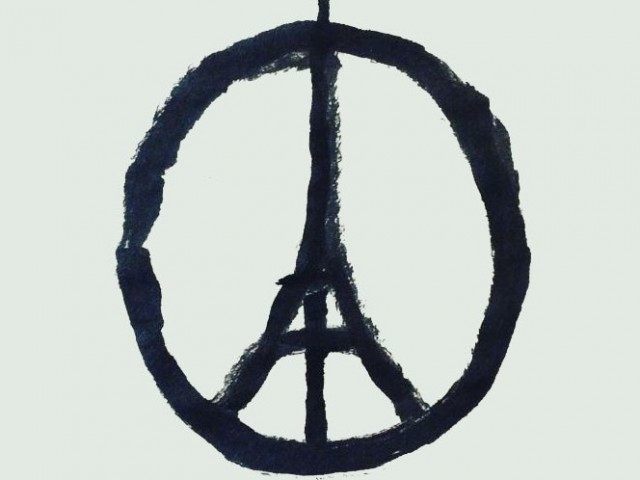 with the Eiffel Tower replacing the nuclear warhead in the middle. For those of you who have missed my warnings about this symbol, the so-called “peace” sign stands for nuclear disarmament, otherwise known as surrender. Regardless of the intentions of the social media user, posting the Eiffel Tower instead of the nuke indicates that you support France’s surrender to jihadi forces. Thus, my initial warning not to post this symbol still stands.
The problems with these kinds of social media campaigns go far beyond misusing an “inappropriate” symbol. Much to the chagrin of my Twitter followers, I have been very vocal about the uselessness of the campaign to re-colorize your profile picture to somehow show solidarity with the French people. What many people assume to be a simple way for low-information voters to proclaim their knowledge and position regarding the Paris attacks actually serves as a cover or penance for those people that support the very policies that allowed this attack to occur with such magnitude.
 Take Debbie Wasserman-Schulz, the chair of the DNC for example. She supports the strict gun control measures that prevent the average French citizen from acquiring weapons and thus preventing the average person from defending themselves. This is the very reason that the so-called “gun free zone” that is Paris was chosen as the venue for this attack in the first place, as there is no one around with the ability to stop the attackers.
Should Debbie rethink her policy positions? Have no fear, Facebook is here! Debbie can just re-colorize her profile picture to show that she feels bad about those attacks without having to face any kind of backlash over the policies she supports that create the kinds of environments that allow these attacks to occur.
I know the re-colorized profiles reading this post are going to take all of what I have said personally and probably need to recover in a safe space for a week. However, the reality is your re-colorized photo does nothing of real use to help the people suffering from this outrageous attack. All it really does is provide a feel-good way of expressing your “good vibes” toward a situation that you will ultimately forget about in a week, if not less.
This is why I would encourage my readers to educate themselves about what really can be done in order to prevent these kinds of attacks from occurring in the future, and start becoming active in their local communities to get good policies enacted so that we can avoid attacks like this on our own soil.
This is the legacy of the Paris attacks: will your support go beyond a profile picture?
(The French Peace Sign picture file above is a screen capture from Breitbart News and complies with Fair Use policy: click here.)
#ConcernedStudent1950 vs the media
Why the Constitution is NOT a Living Document
One of the more popular contemporary interpretations of the Constitution is the notion that it is a living document, or that its meaning changes over time. Indeed, it is easy to think that a document that is more than 200 years old might by now become at least a little outdated, or even irrelevant. However, my contention is that the values and principles embodied in the Constitution are just as relevant today as they were when the founders first created it. With this in mind, the Constitution should be interpreted not as a living document, but as close to the original intent that the Founders had in mind.
The most important reason why the Constitution should not be interpreted as a living document is that it opens the door for all other kinds of ideas to be read into its meaning. This is a major flaw with those who adhere to a nonoriginal approach to interpreting the Constitution; of all of the approaches it is the, “most vulnerable to the charge of illegitimacy,” (May, Ides, 2013, p. 39). Who is to say what parts of the Constitution are outdated and which parts are not? Without a baseline of original meaning, the consistency of rulings is put in danger—one judge may read new meaning into a phrase in the Constitution for one reason, another may read something completely different into that same phrase for other reasons. An original intent approach seeks to preserve the ideals that the Constitution was designed to uphold, rather than risk its perversion with a living document approach.
One of the problems that our textbook claims is associated with an originalist approach to the Constitution is that it causes the document to be unable to address the new and contemporary issues that did not exist at the time of its creation. This argument cites the different types of speech—radio, T.V., Internet—that did not exist in the 1700s that under a strict and specific version of originalism could be rendered unprotected under the 1st Amendment (May, Ides, 2013, p. 38). This approach, however, is actually a form of textualism rather than originalism, taking only the strict meaning of the words of the Constitution—which actually could rule out even some forms of speech available in the 1700s—and disregarding the principle of free speech that the Founders originally intended to uphold.
References
May, C. N. Idea, A. (2013) Constitutional Law: National Power and Federalism. New York: Wolters Kluwer Law & Business.
 WarriorWoman91